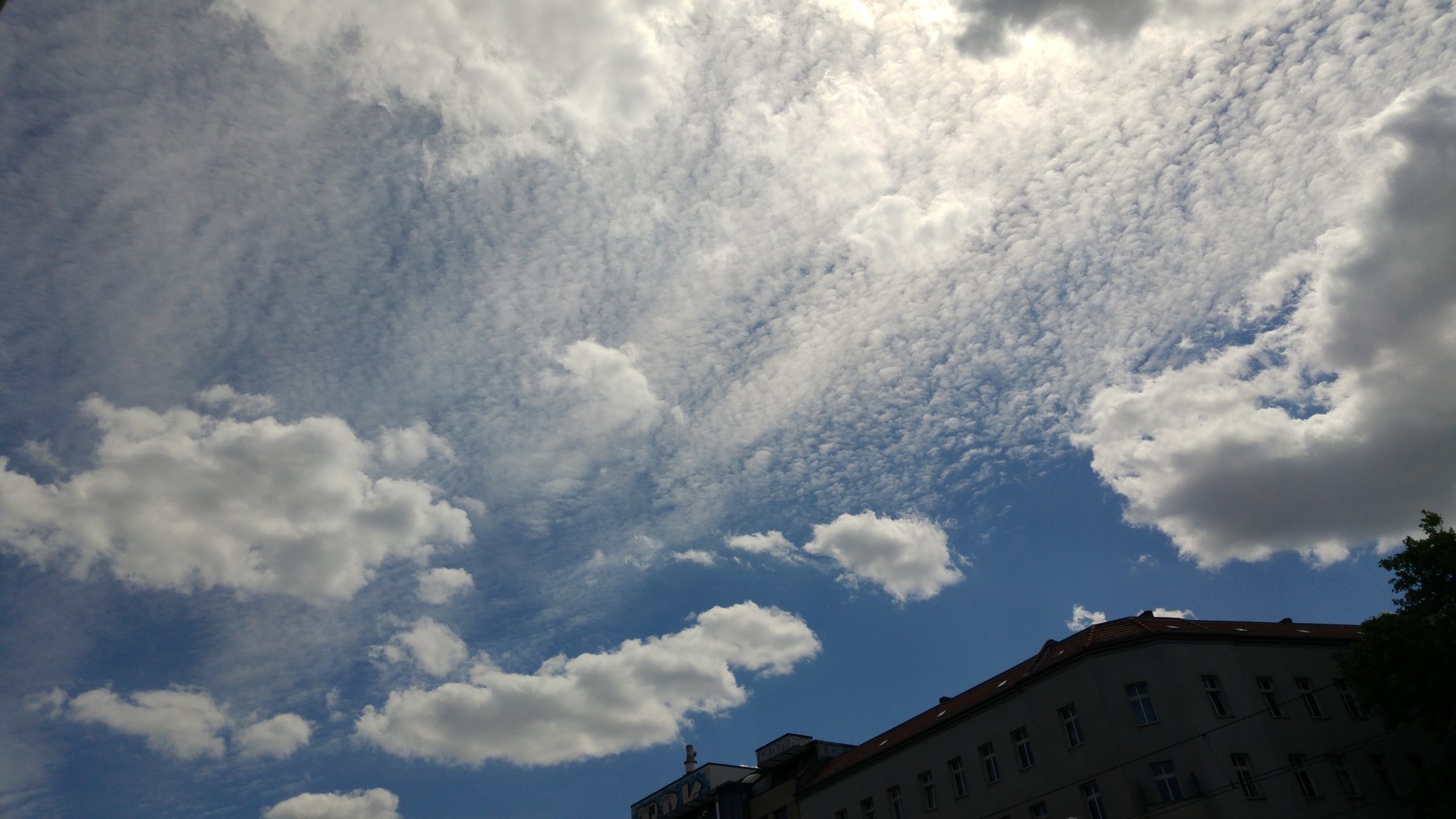
Cirrocumulus stratiformis Cc str
Genus Cirrocumulus, Species stratiformis
Also visible
- Photo
- Stefan Bauer
- Location
- Berlin, Germany · on the map
- Taken
- 11 June 2016, 12:59
Above the low Cumulus humilis clouds spreads a layer of very small, densely packed cloud elements. Their fine grain and the barely discernible self-shadowing indicate Cirrocumulus stratiformis. To the right of the center of the image, patches of blue sky shine through between the grains.
The weather that day
Does the weather fit the cloud?
Cumulus ✓ observed Observer at Berlin-Tegel · 8 km · 13:00 Reanalysis: possible Why?
- Observation: An observer at the Berlin-Tegel station (8 km, 13:00) reports Cumulus.
- Reanalysis (13:00), possible: 0 % low, 55 % middle, 20 % high cloud. In daytime thermals reach 2,400 m, the condensation level (dew-point spread 17.9 °C × 125 m) is at 2,250 m – rising air condenses. This usually produces separate heap clouds – too small for the reanalysis to show them as significant low cloud.
Formation: Heap cloud: warm air bubbles (thermals) rise, cool and condense at the condensation level – hence the flat base. How tall they grow depends on the instability above.
How is this rated?
Observation before model: what an observer at a weather station reported counts for more than an estimate from a station’s instruments and more than the weather model. Each piece of information counts for less the farther away the station and the further from the time of the photo; the strongest comes first. The ERA5 reanalysis (grid point at the photo location, about 25 km grid spacing) only knows the cover per étage and values at the ground – its level is a rough estimate.
The sky through the day
Photo Cirrocumulus stratiformis, Cumulus humilis · 13:00
6:00
9:00
12:00
13:00 · hour of the photo
15:00
18:00
21:00
- ✓observed
- estimated: ●●● likely ●●○ quite possible ●○○ possible
- Photoalso in the photo
How to read the day
- Times – click to see the sky at that hour. Below them the codes of the reported genera, grey = estimated only.
- clear = observer reports no clouds · none meas. = instrument detected none · ? = no data · – = partly hidden or without data (details on hover).
- ✓ = reported by a weather station, dots = estimated from height and cover (automatic measurement) or from the weather model. The bar next to the étage shows the cover.
- The stations see their own sky – not necessarily the cloud in the photo.
Large-scale weather pattern
South-shifted westerly Ws
The westerly flow lies further south and lows cross central Europe directly. Frequent rain from nimbostratus and altostratus, windy; in winter often snow along the boundary between mild and cold air.
Typical clouds in this pattern: Nimbostratus Altostratus Stratocumulus Cumulonimbus
The weather pattern describes the flow over central Europe on that day – locally, the sky may have looked different.
Weather station measurements at the time of the photo
Measured at the nearest weather stations, not where the photo was taken – conditions there may have differed.
- Temperature
- 20.3 °C · Dew point 3.0 °C
- Berlin-Tempelhof · 6 km S
- Humidity
- 32 %
- Berlin-Tempelhof · 6 km S
- Wind
- from the north-west, 9 km/h (Beaufort 2)
- Berlin-Tempelhof · 6 km S
- Precipitation
- none measured – incomplete record (22 of 24 hours)
- Berlin-Tempelhof · 6 km S
- Sun in the hour of the photo
- 900 W/m² global radiation · 58 of 60 min sunshine
- Potsdam · 29 km SW
Between 19:00 and 21:00 the temperature dropped by 4.7 °C.
Rule of thumb for the base of heap clouds: about 2,150 m above the station (125 m per degree between temperature and dew point).
Sources: observations and measurements from Deutscher Wetterdienst, the German weather service (CC BY 4.0), Berlin-Tempelhof (6 km S), Potsdam (29 km SW); weather pattern after Hess/Brezowsky from the DWD catalogue GWL-REA; ERA5 reanalysis by Copernicus/ECMWF (CC BY 4.0) via Open-Meteo. Times in local time.

Write a comment or ask a question about this photo
Every comment is read before it is published. Your email address is only needed for the confirmation link and a short message once the comment is online; it is deleted after that.