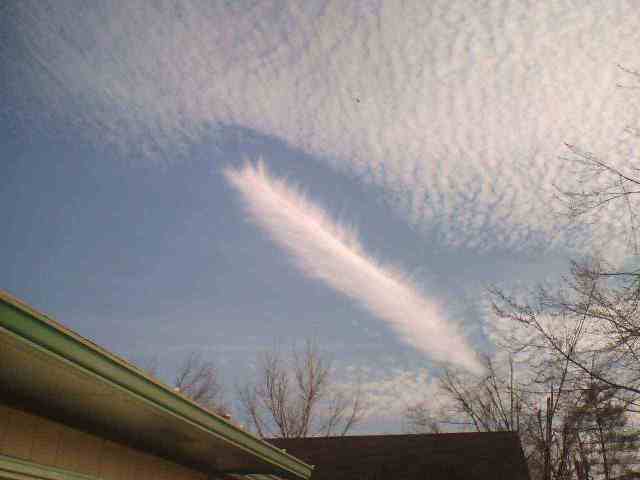
Cirrus vertebratus Ci ve
Genus Cirrus, Variety vertebratus
- Photo
- Bill Lear
- Location
- Broken Arrow, Oklahoma, USA
- Taken
- 12 February 2008, 16:30
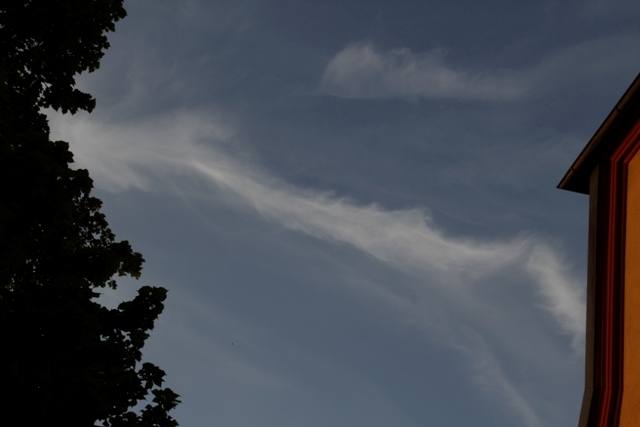
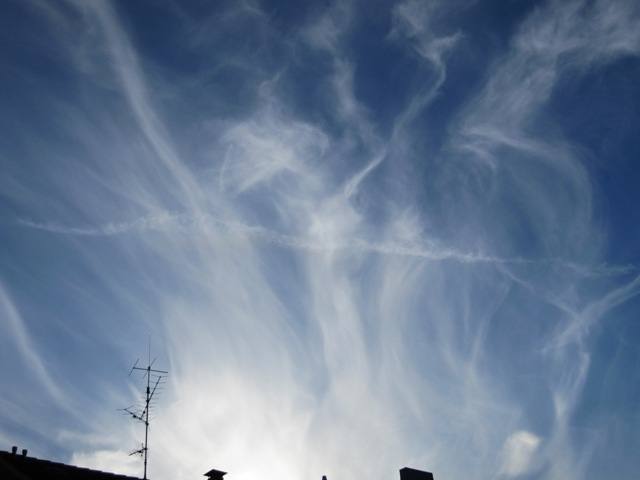
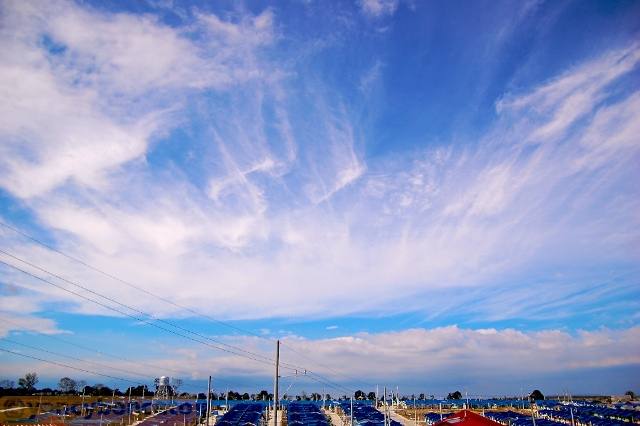
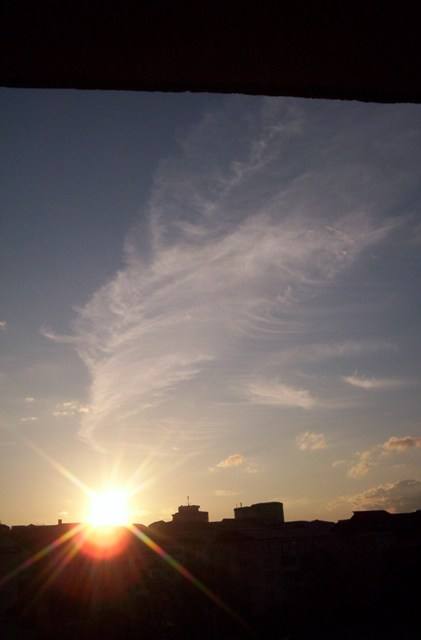
The fan-shaped formation in the center of the image is called Cirrus vertebratus, due to its resemblance to a spine or fishbone. Around this vertebratus, especially to the right of the cloud, a cloud hole forms, followed by a sharp boundary to the surrounding Altocumulus field. This phenomenon is known as a Hole Punch Cloud. It is suspected that falling ice crystals cause these holes in the cloud layer. The ice crystals grow at the expense of surrounding water droplets (Bergeron-Findeisen process), leading to this cloud arrangement.
The weather that day
The sky at nearby weather stations
In the photo: Cirrus vertebratus · 17:00
As under “Identify”: ✓ = reported by a weather station, dots = estimated from height and cover (automatic measurement). The stations see their own sky – not necessarily the cloud in the photo.
Does the weather fit the cloud?
Cirrus – according to the reanalysis quite possible (15:00) · Why?
- Reanalysis: High cloud 23 %.
- High ice clouds, only partly covering the sky: cirrus.
Formation: Ice cloud at great height (usually above 6 km, below about −35 °C). Forms when moist air is lifted high up, or as left-over ice from convective clouds and contrails; falling crystals make the fibres.
Simplified rules applied to the ERA5 reanalysis for this day (grid point at the photo location, about 25 km grid spacing). The reanalysis only knows the cover per étage and values at the ground – the level is a rough estimate, not a measurement.
Measurements at the time of the photo
- Temperature
- 1.1 °C · Dew point -7.2 °C
- Humidity
- 54 %
- Wind
- from the north, 15 km/h (Beaufort 3)
- Precipitation
- none measured
Sources: weather reports from the Integrated Surface Database of NOAA (NCEI), Richard Lloyd Jones Jr Apt (18 km W); ERA5 reanalysis by Copernicus/ECMWF (CC BY 4.0) via Open-Meteo. Times in local time.

Write a comment or ask a question about this photo
Every comment is read before it is published. Your email address is only needed for the confirmation link and a short message once the comment is online; it is deleted after that.