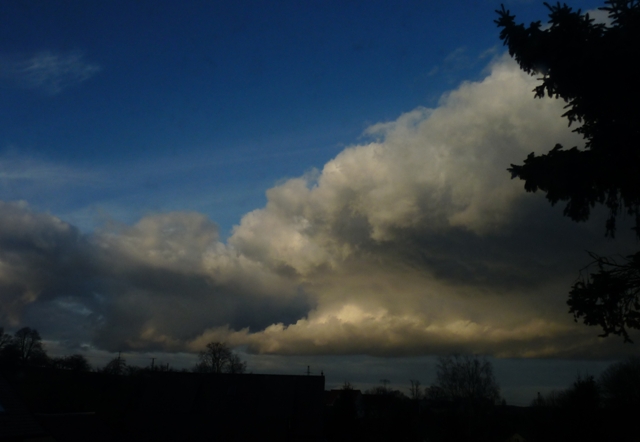
Cumulus congestus Cu con
Genus Cumulus, Species congestus
- Photo
- Mario Springer
- Location
- Chemnitz
- Taken
- 13 March 2009, 18:07
This Cumulus congestus in the left half of the photo features a broad and sharp base.
Strongly ragged edges, especially in the left part of the image, indicate Cumulus fractus clouds.
The weather that day
Does the weather fit the cloud?
Cumulus ✓ observed Observer at Chemnitz · 6 km · 17:00 Reanalysis: quite possible Why?
- Observation: An observer at the Chemnitz station (6 km, 17:00) reports Cumulus.
- Reanalysis (18:00), quite possible: 37 % low, 28 % middle, 15 % high cloud. In daytime thermals reach 700 m, the condensation level (dew-point spread 2.7 °C × 125 m) is at 350 m – rising air condenses. Thermals reach only a little above the condensation level: flat fair-weather clouds (humilis).
Formation: Heap cloud: warm air bubbles (thermals) rise, cool and condense at the condensation level – hence the flat base. How tall they grow depends on the instability above.
How is this rated?
Observation before model: what an observer at a weather station reported counts for more than an estimate from a station’s instruments and more than the weather model. Each piece of information counts for less the farther away the station and the further from the time of the photo; the strongest comes first. The ERA5 reanalysis (grid point at the photo location, about 25 km grid spacing) only knows the cover per étage and values at the ground – its level is a rough estimate.
The sky through the day
Photo Cumulus congestus · 18:00
6:00
9:00
12:00
15:00
18:00 · hour of the photo
21:00
- ✓observed
- estimated: ●●● likely ●●○ quite possible ●○○ possible
- Photoalso in the photo
How to read the day
- Times – click to see the sky at that hour. Below them the codes of the reported genera, grey = estimated only.
- clear = observer reports no clouds · none meas. = instrument detected none · ? = no data · – = partly hidden or without data (details on hover).
- ✓ = reported by a weather station, dots = estimated from height and cover (automatic measurement) or from the weather model. The bar next to the étage shows the cover.
- The stations see their own sky – not necessarily the cloud in the photo.
Large-scale weather pattern
Angular westerly Ww
The westerly flow bends over central Europe because a high in the east blocks its path. Fronts move slowly or stall: longer spells of grey, wet weather in the west and south, often brighter in the east.
Typical clouds in this pattern: Altostratus Nimbostratus Stratocumulus Cirrostratus
The weather pattern describes the flow over central Europe on that day – locally, the sky may have looked different.
Weather station measurements at the time of the photo
Measured at the weather station Chemnitz, 6 km SW of where the photo was taken – not at the photo location itself, where conditions may have differed.
- Temperature
- 6.4 °C · Dew point 3.5 °C
- Humidity
- 82 %
- Wind
- from the west, 18 km/h (Beaufort 3)
- Precipitation
- 1.7 mm over the whole day
- Sun in the hour of the photo
- 8 W/m² global radiation · 0 of 60 min sunshine
Rule of thumb for the base of heap clouds: about 350 m above the station (125 m per degree between temperature and dew point).
Sources: observations and measurements from Deutscher Wetterdienst, the German weather service (CC BY 4.0), Chemnitz (6 km SW); weather pattern after Hess/Brezowsky from the DWD catalogue GWL-REA; ERA5 reanalysis by Copernicus/ECMWF (CC BY 4.0) via Open-Meteo. Times in local time.
Similar photos
-
 Cumulonimbus capillatus incus +1 District of Dachau 2012
-
 Altocumulus stratiformis perlucidus translucidus undulatus +2 Jakarta 2011
-
 Cumulus mediocris +2 over Hungary 2011
-
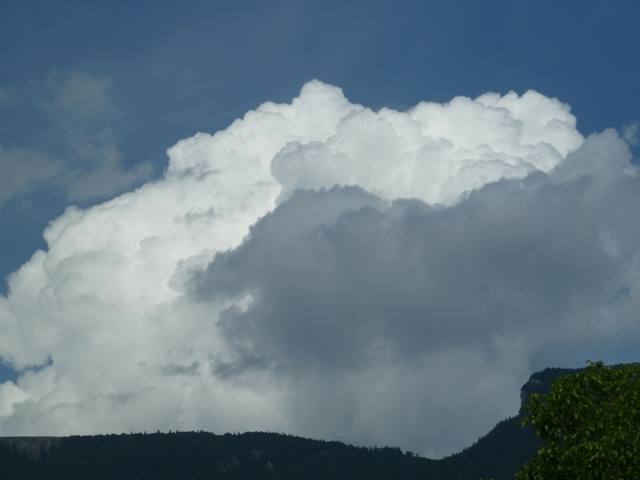 Cumulus congestus Selzach 2011
-
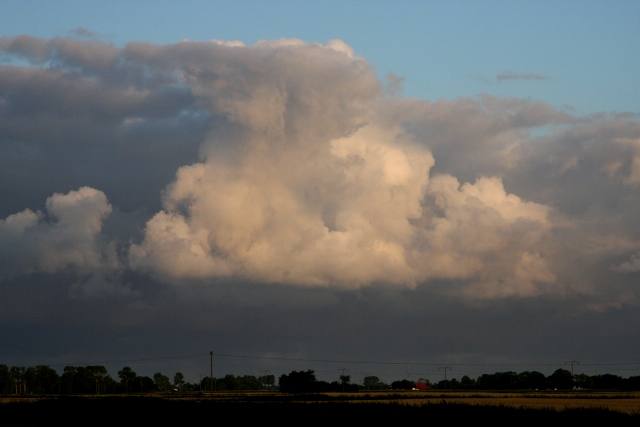 Cumulus congestus Sankt Michaelisdonn 2009
-
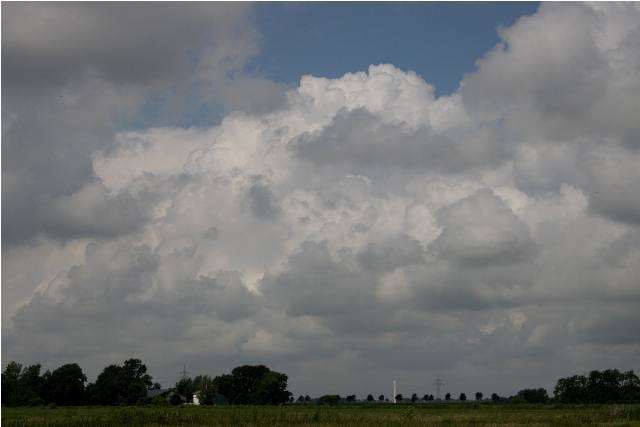 Cumulus congestus Sankt Michaelisdonn 2009
-
 Cumulus congestus Iraklio 2009
-
 Cumulus congestus Rome 2009
Write a comment or ask a question about this photo
Every comment is read before it is published. Your email address is only needed for the confirmation link and a short message once the comment is online; it is deleted after that.