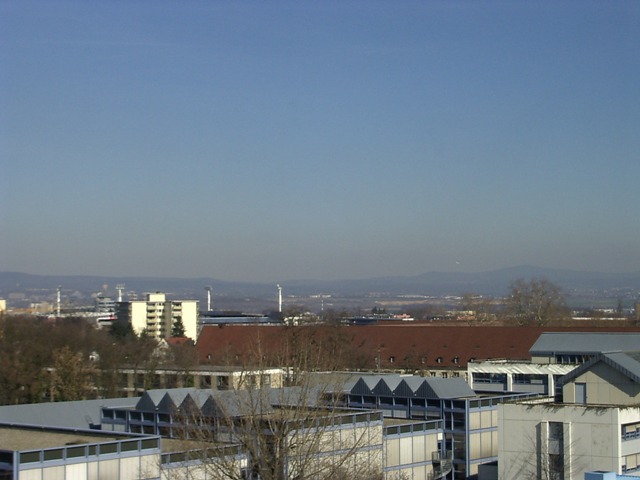
Inversion
Visible: Inversion
- Photo
- Stefan Bauer
- Location
- Mainz
- Taken
- 12 March 2007, 11:56
Over the Rhine-Main area, a near-surface pollution layer has formed. A high-pressure weather situation is characterised by the subsidence of air masses, which act like a lid over the near-surface air layers. Vertical exchange and thus ventilation of the near-surface air is no longer possible. This is referred to as an inversion layer because near the surface temperature increases with height and decreases again above the inversion boundary.
The weather that day
Large-scale weather pattern
Anticyclonic bridge across central Europe BMa
A ridge of high pressure links the Azores high with a high over eastern Europe. Similar to “High over central Europe”: fair-weather cumulus in summer, persistent fog and low stratus in winter.
Typical clouds in this pattern: Cumulus, Stratus, Stratocumulus, Cirrus
The weather pattern describes the flow over central Europe on that day – locally, the sky may have looked different.
Clouds at nearby weather stations
| Station | 6:00 | 9:00 | 12:00 · Photo | 15:00 | 18:00 | 21:00 |
|---|---|---|---|---|---|---|
| Frankfurt/Main18 km E | Ci | Ci | Ci | Ci | Ci | clear |
Abbreviations = reported cloud genera, from low to high; grey = only cover in oktas and cloud base reported (automatic measurement or airport report). Each station sees its own sky – not necessarily the cloud in the photo.
Measurements at the time of the photo
- Temperature
- 12.0 °C · Dew point -0.6 °C
- Humidity
- 42 %
- Wind
- from the north-east, 10 km/h (Beaufort 2)
- Precipitation
- none measured
Between 18:00 and 20:00 the temperature dropped by 4.6 °C.
Sources: observations and measurements from Deutscher Wetterdienst, the German weather service (CC BY 4.0), Wiesbaden-Auringen (17 km N), Frankfurt/Main (18 km E), Wiesbaden-Biebrich (8 km NW); weather pattern after Hess/Brezowsky from the DWD catalogue GWL-REA. Times in local time.
Write a comment or ask a question about this photo
Every comment is read before it is published. Your email address is only needed for the confirmation link and a short message once the comment is online; it is deleted after that.