
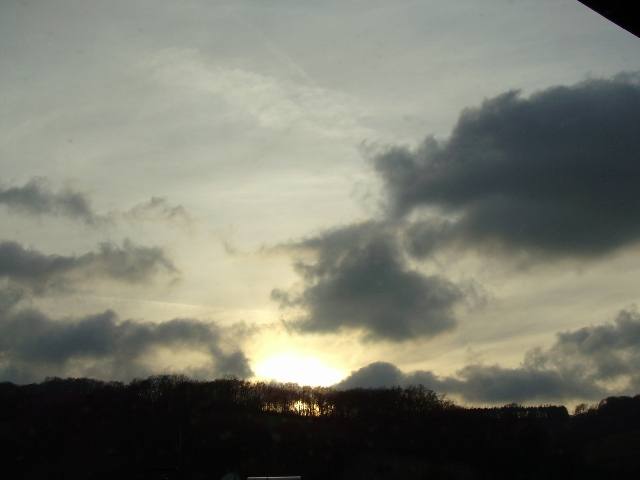
Sun dog in Cirrostratus
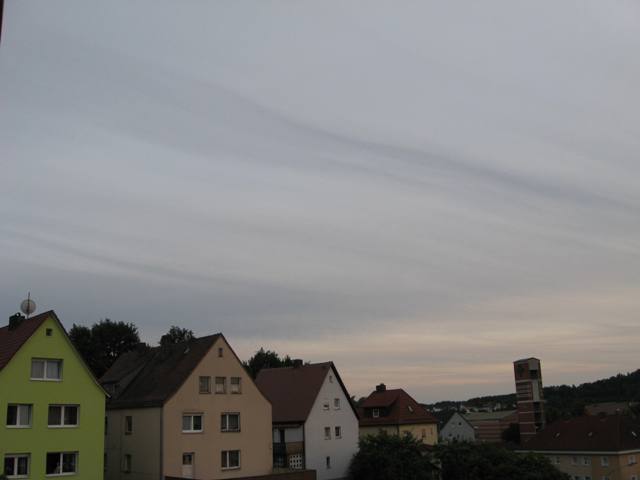
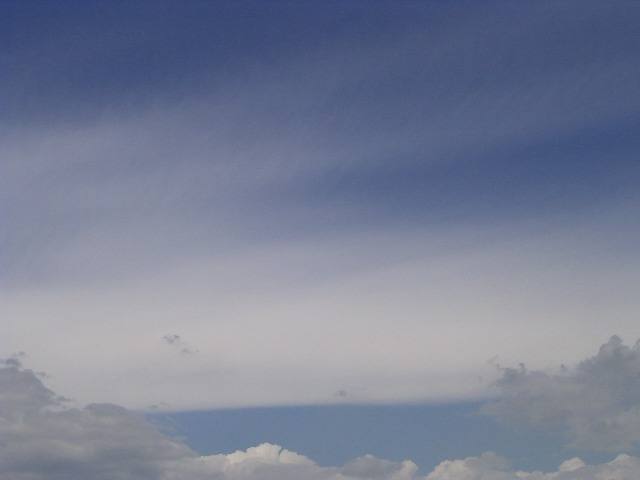
Cirrostratus fibratus Cs fib
Genus Cirrostratus, Species fibratus
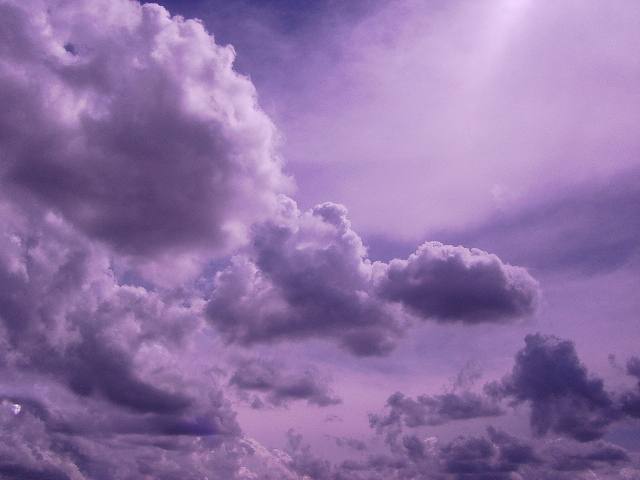
Cirrocumulus floccus Cc flo
Genus Cirrocumulus, Species floccus
Also visible: Sun dog
- Photo
- Stefan Bauer
- Location
- Berlin-Wannsee, Germany
- Taken
- 20 December 2025, 13:46
To the right of the low sun, a colourful sundog shines in a thin veil of Cirrostratus fibratus. It forms when sunlight is refracted by horizontally oriented, hexagonal ice crystals. The sundog appears reddish towards the sun. Fine cloud flecks can be seen at the top and at the right edge of the image, possibly Cirrocumulus floccus.
The weather that day
Does the weather fit the cloud?
Cirrostratus fibratus quite possible Weather model · 12:00 Why?
- Weather model (12:00), quite possible: High ice clouds cover 100 % as a thin layer: cirrostratus.
Formation: Ice veil, usually formed by slow large-scale lifting ahead of a warm front; as it thickens and lowers it turns into altostratus.
How is this rated?
Observation before model: what an observer at a weather station reported counts for more than an estimate from a station’s instruments and more than the weather model. Each piece of information counts for less the farther away the station and the further from the time of the photo; the strongest comes first. The ICON weather model is read with the same rules as the cloud forecast (archived forecast for this day, grid point at the photo location). As under “Sky now”, the satellite serves as an exclusion criterion: if it sees no matching cloud tops nearby, estimates count less; observations stay.
Seen from above satellite at 1:50 pm, photo taken 1:46 pm
Clouds within 25 km (1:45 pm)
The satellite only sees the topmost cloud layer and measures its top – not the base by which the levels are defined. It looks down on an area; the photo shows part of the sky from below.
The sky through the day
Photo Cirrostratus fibratus, Cirrocumulus floccus · 14:00
6:00
9:00
12:00
14:00 · hour of the photo
15:00
18:00
21:00
- ✓observed
- estimated: ●●● likely ●●○ quite possible ●○○ possible
- Photoalso in the photo
How to read the day
- Times – click to see the sky at that hour. Below them the codes of the reported genera, grey = estimated only.
- clear = observer reports no clouds · none meas. = instrument detected none · ? = no data · – = partly hidden or without data (details on hover).
- ✓ = reported by a weather station, dots = estimated from height and cover (automatic measurement) or from the weather model. The bar next to the étage shows the cover.
- The stations see their own sky – not necessarily the cloud in the photo.
Large-scale weather pattern
Anticyclonic south-westerly SWa
A high over south-eastern Europe draws in warm air from the south-west. Plenty of sun, hot in summer; on some days high clouds and altocumulus castellanus show that thunderstorms are brewing. Mild in winter, with fog and low stratus in valleys.
Typical clouds in this pattern: Cirrus Altocumulus Cumulus Stratus
The weather pattern describes the flow over central Europe on that day – locally, the sky may have looked different.
Weather station measurements at the time of the photo
Measured at the nearest weather stations, not where the photo was taken – conditions there may have differed.
- Temperature
- 8.3 °C · Dew point 6.3 °C
- Potsdam · 8 km SW
- Humidity
- 87 %
- Potsdam · 8 km SW
- Wind
- from the north, 3 km/h (Beaufort 1)
- Potsdam · 8 km SW
- Precipitation
- none measured
- Berlin-Colonie Alsen · 1 km E
- Sun in the hour of the photo
- 133 W/m² global radiation · 40 of 60 min sunshine
- Potsdam · 8 km SW
Sources: observations and measurements from Deutscher Wetterdienst, the German weather service (CC BY 4.0), Potsdam (8 km SW), Berlin-Colonie Alsen (1 km E); weather pattern after Hess/Brezowsky from the DWD catalogue GWL-REA; DWD ICON weather model via Open-Meteo (archived forecasts). Contains modified EUMETSAT Meteosat data 2025 (GeoColour, cloud top height, CC BY 4.0), night background NASA Black Marble. Times in local time.


Write a comment or ask a question about this photo
Every comment is read before it is published. Your email address is only needed for the confirmation link and a short message once the comment is online; it is deleted after that.