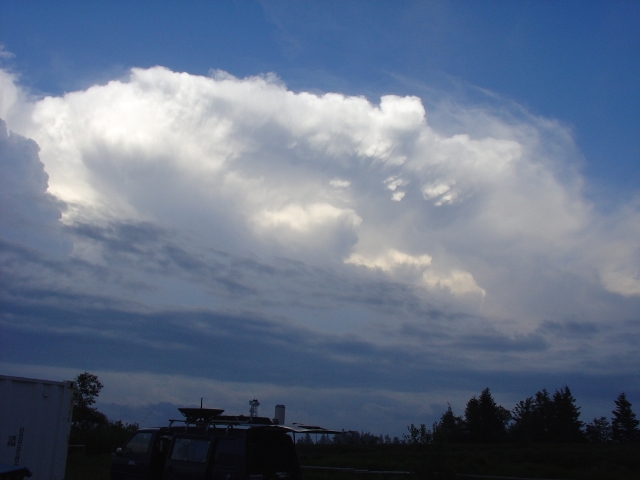
Cumulonimbus capillatus incus mamma Cb cap inc mam
Genus Cumulonimbus, Species capillatus, Supplementary feature incus, Supplementary feature mamma
Also visible
Stratocumulus radiatus Sc ra
Genus Stratocumulus, Variety radiatus
- Photo
- Marcus Radlach
- Location
- Hornisgrinde, Black Forest
- Taken
- 20 June 2007, 19:37
A cumulonimbus in anvil form (Cumulonimbus incus) with fibrous edges (Cumulonimbus capillatus). Below the cumulonimbus shield on the right, warty protrusions have formed, called Cumulonimbus mamma. In the lower layers, Stratocumulus radiatus can be seen.
The weather that day
Large-scale weather pattern
High over the Norwegian Sea, cyclonic HNz
A high over the Norwegian Sea while lows move across central and southern Europe. Cool and changeable, often rain from nimbostratus or showers from cumulus and cumulonimbus.
Typical clouds in this pattern: Nimbostratus, Stratocumulus, Cumulus, Cumulonimbus
The weather pattern describes the flow over central Europe on that day – locally, the sky may have looked different.
The sky at nearby weather stations
In the photo: Cumulonimbus capillatus incus mamma, Stratocumulus radiatus · 20:00
As under “Identify”: ✓ = reported by a weather station, dots = estimated from height and cover (automatic measurement). The stations see their own sky – not necessarily the cloud in the photo.
Does the weather fit the cloud?
Cumulonimbus – observed at a weather station ✓ (Freudenstadt · 25 km · further away · 20:00) · Reanalysis quite possible · Why?
- Observation: An observer at the Freudenstadt station (25 km, 20:00) reports Cumulonimbus.
- Reanalysis (18:00), quite possible: 19 % low, 6 % middle, 66 % high cloud. In daytime thermals reach 1,000 m, the condensation level (dew-point spread 6.4 °C × 125 m) is at 800 m – rising air condenses. Plus 2.9 mm precipitation in the hour: the heap clouds grow tall enough to bring showers. A heavy shower (2.9 mm) in warm air: often from cumulonimbus. The reanalysis does not report thunder – hence only “quite possible”.
Formation: Thundercloud: a heap cloud grows to great heights in very unstable air; its summit glaciates (fibrous) and often spreads out as an anvil. Lightning, thunder, showers, hail.
Stratocumulus stratiformis – according to the reanalysis quite possible (20:00) · Why?
- Reanalysis (20:00), quite possible: 62 % low, 16 % middle, 94 % high cloud. Low cloud without thermals reaching its base: stratocumulus.
Formation: Low layer of clumps or rolls beneath a stable layer (inversion). Forms through radiative cooling and mixing at the cloud top, or when heap clouds spread out under the inversion.
Observation before model: what an observer at a weather station reported counts for more than an estimate from a station’s instruments and more than the weather model. Each piece of information counts for less the farther away the station and the further from the time of the photo; the strongest comes first. The ERA5 reanalysis (grid point at the photo location, about 25 km grid spacing) only knows the cover per étage and values at the ground – its level is a rough estimate.
Measurements at the time of the photo
- Temperature
- 24.8 °C · Dew point 17.8 °C
- Humidity
- 65 %
- Precipitation
- 1.2 mm measured – incomplete record (22 of 24 hours)
Rule of thumb for the base of heap clouds: about 900 m above the station (125 m per degree between temperature and dew point).
Sources: observations and measurements from Deutscher Wetterdienst, the German weather service (CC BY 4.0), Baden-Baden-Geroldsau (14 km NE), Baiersbronn-Ruhestein (7 km SE); weather pattern after Hess/Brezowsky from the DWD catalogue GWL-REA; ERA5 reanalysis by Copernicus/ECMWF (CC BY 4.0) via Open-Meteo. Times in local time.
Similar photos
-
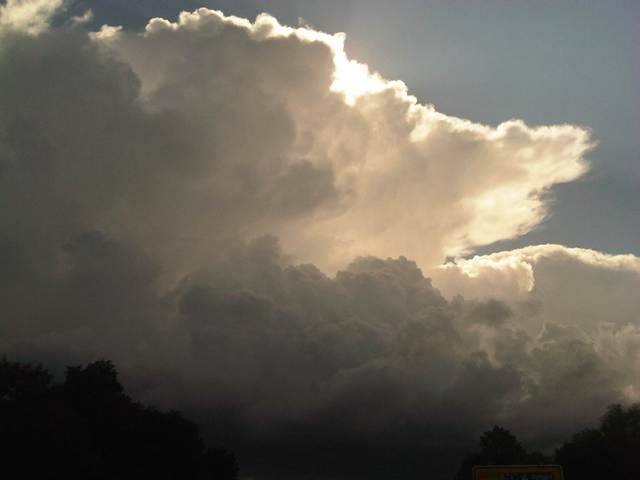 Cumulonimbus capillatus incus +1 District of Dachau 2012
-
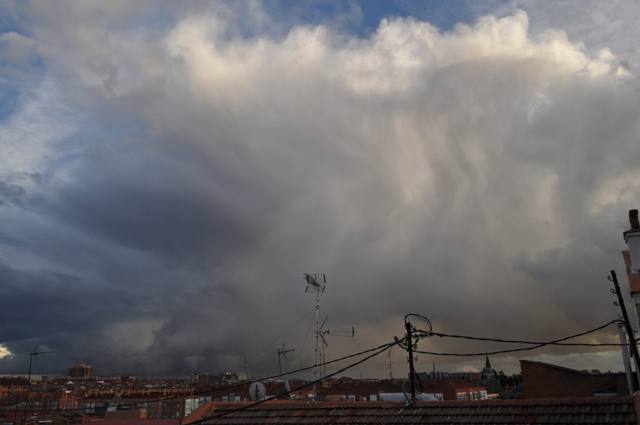 Cumulonimbus capillatus Madrid 2010
-
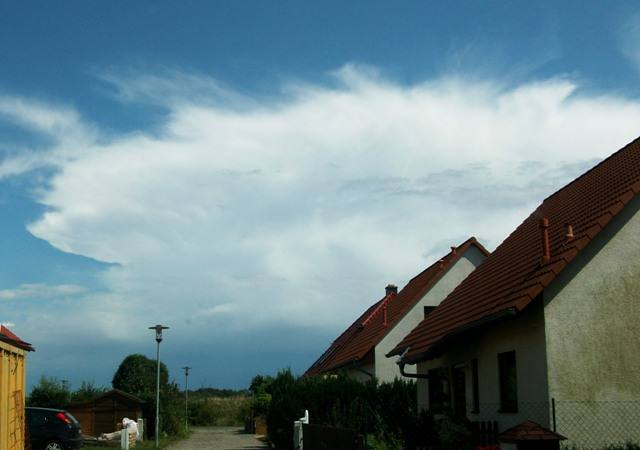 Cumulonimbus capillatus Leipzig 2009
-
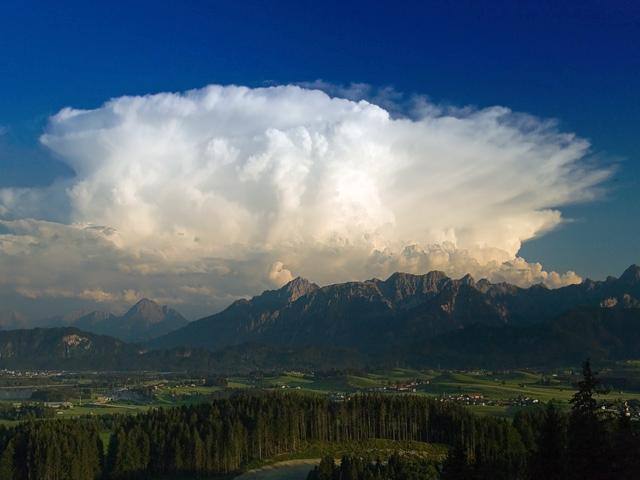 Cumulonimbus capillatus southern Ostallgäu 2007
-
 Cumulonimbus capillatus Mainz 2007
-
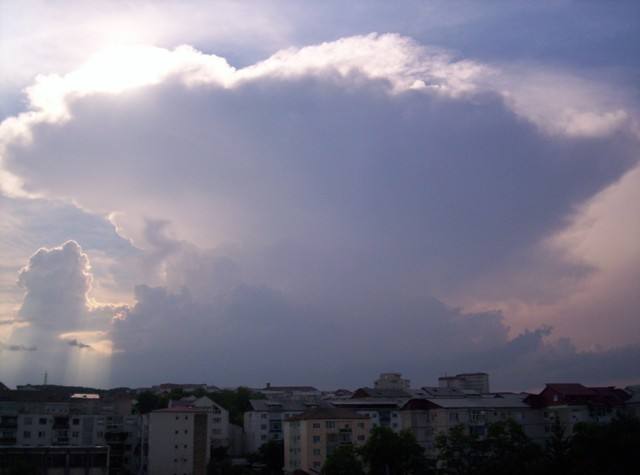 Cumulonimbus capillatus Zalau 2007
-
 Cumulonimbus capillatus Leipzig 2004
-
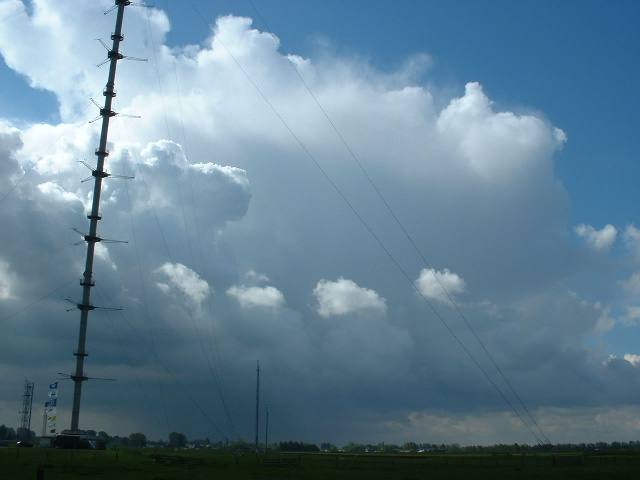 Cumulonimbus capillatus +2 Netherlands
Write a comment or ask a question about this photo
Every comment is read before it is published. Your email address is only needed for the confirmation link and a short message once the comment is online; it is deleted after that.