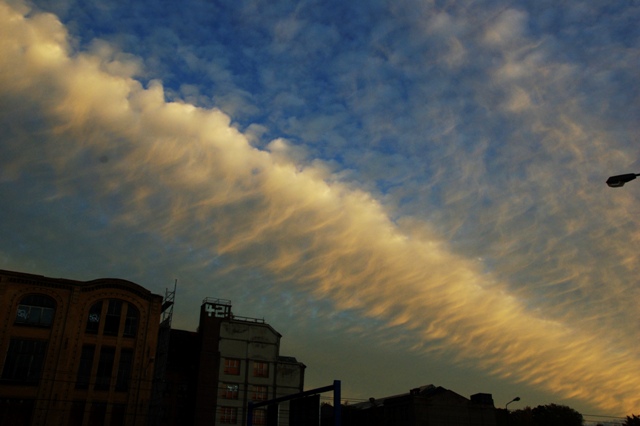
Stratocumulus radiatus Sc ra
Genus Stratocumulus, Variety radiatus
Also visible
Stratocumulus virga Sc vir
Genus Stratocumulus, Supplementary feature virga
Altocumulus Ac
Genus Altocumulus
- Photo
- Patric Seifert
- Location
- Chemnitz
- Taken
- 26 October 2009
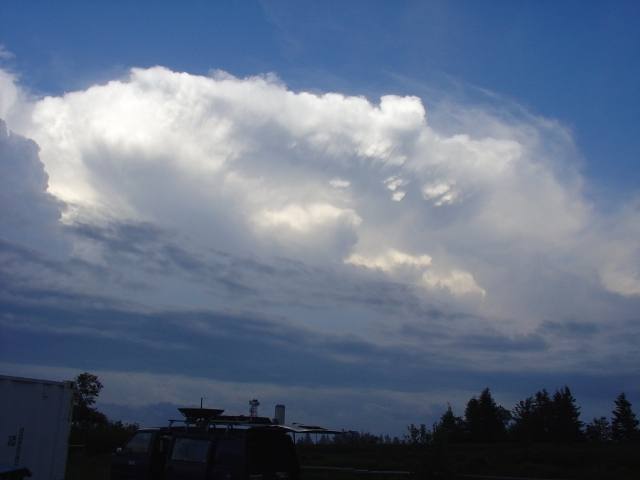
A radiant arrangement of Stratocumulus, known as Stratocumulus radiatus. Below, virga can even be seen (Stratocumulus virga). Above, Altocumulus cloudiness.
The weather that day
Does the weather fit the cloud?
Stratocumulus ✓ observed Observer at Chemnitz · 6 km · 6:00 Reanalysis: quite possible Why?
- Observation: An observer at the Chemnitz station (6 km, 6:00) reports Stratocumulus.
- Station measurement: Chemnitz (6 km, 5:00), likely: The instrument reports a layer at 1,250 m, 7/8 covered. The base lies well above the condensation level of surface air (about 100 m): not a thermal cloud but a layer – stratocumulus.
- Reanalysis (11:00), quite possible: 68 % low, 7 % middle, 0 % high cloud. In daytime thermals reach 650 m, the condensation level (dew-point spread 3.4 °C × 125 m) is at 450 m – rising air condenses. Low cloud 68 %: the heap clouds spread out beneath a stable layer into a deck.
Formation: Low layer of clumps or rolls beneath a stable layer (inversion). Forms through radiative cooling and mixing at the cloud top, or when heap clouds spread out under the inversion.
Altocumulus ✓ observed Observer at Chemnitz · 6 km · 10:00 Reanalysis: quite possible Why?
- Observation: An observer at the Chemnitz station (6 km, 10:00) reports Altocumulus.
- Reanalysis (12:00), quite possible: Middle cloud 27 %. Partly covered: middle cloud patches are usually altocumulus.
Formation: Layer at middle height (2–6 km), usually a few hundred metres thick. Radiative cooling at the top and mixing create small overturning cells – hence clumps, rolls and waves.
How is this rated?
Observation before model: what an observer at a weather station reported counts for more than an estimate from a station’s instruments and more than the weather model. Each piece of information counts for less the farther away the station and the further from the time of the photo; the strongest comes first. The ERA5 reanalysis (grid point at the photo location, about 25 km grid spacing) only knows the cover per étage and values at the ground – its level is a rough estimate.
The sky through the day
Photo Stratocumulus radiatus, Stratocumulus virga, Altocumulus
6:00
9:00
12:00
15:00
18:00
21:00
- ✓observed
- estimated: ●●● likely ●●○ quite possible ●○○ possible
- Photoalso in the photo
How to read the day
- Times – click to see the sky at that hour. Below them the codes of the reported genera, grey = estimated only.
- clear = observer reports no clouds · none meas. = instrument detected none · ? = no data · – = partly hidden or without data (details on hover).
- ✓ = reported by a weather station, dots = estimated from height and cover (automatic measurement) or from the weather model. The bar next to the étage shows the cover.
- The stations see their own sky – not necessarily the cloud in the photo.
Large-scale weather pattern
Anticyclonic westerly Wa
High pressure over southern Europe extends into central Europe while lows pass far to the north. Mostly dry, warm in summer and mild in winter; the north is sometimes brushed by cloud bands of decaying fronts.
Typical clouds in this pattern: Cumulus Stratocumulus Photo Cirrus
The weather pattern describes the flow over central Europe on that day – locally, the sky may have looked different.
Weather station measurements that day
Measured at the weather station Chemnitz, 6 km SW of where the photo was taken – not at the photo location itself, where conditions may have differed.
- Temperature
- 6.4 to 12.2 °C
- Precipitation
- 1.1 mm over the whole day
- Sun
- 3.8 hours of sunshine over the whole day
Sources: observations and measurements from Deutscher Wetterdienst, the German weather service (CC BY 4.0), Chemnitz (6 km SW); weather pattern after Hess/Brezowsky from the DWD catalogue GWL-REA; ERA5 reanalysis by Copernicus/ECMWF (CC BY 4.0) via Open-Meteo. Times in local time.

Write a comment or ask a question about this photo
Every comment is read before it is published. Your email address is only needed for the confirmation link and a short message once the comment is online; it is deleted after that.