
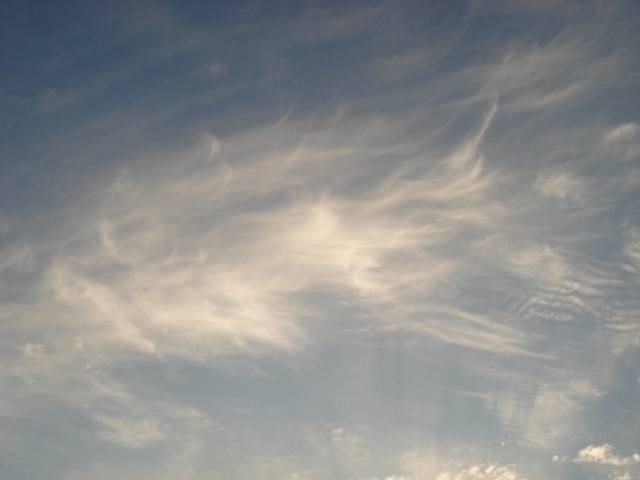
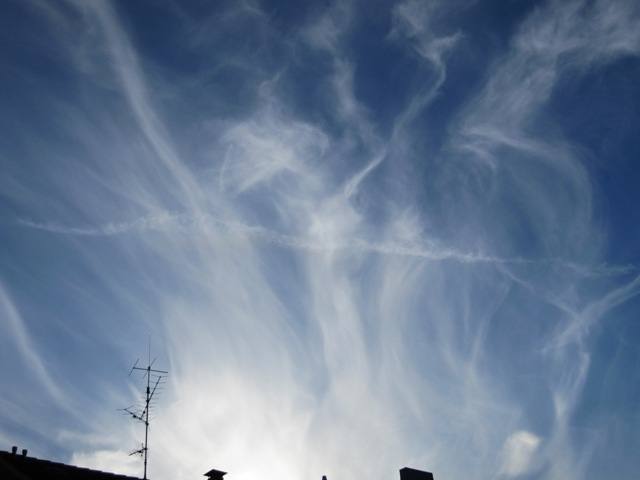
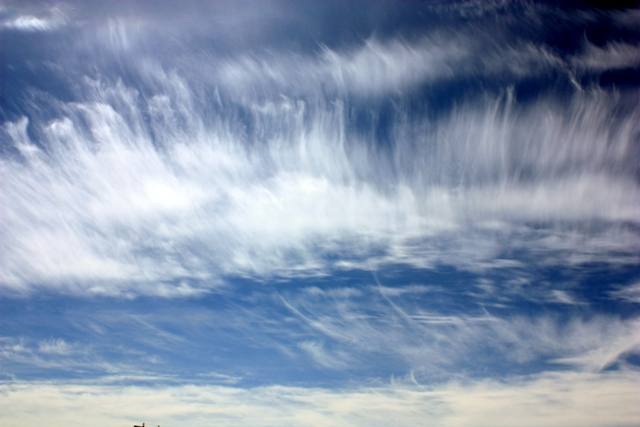
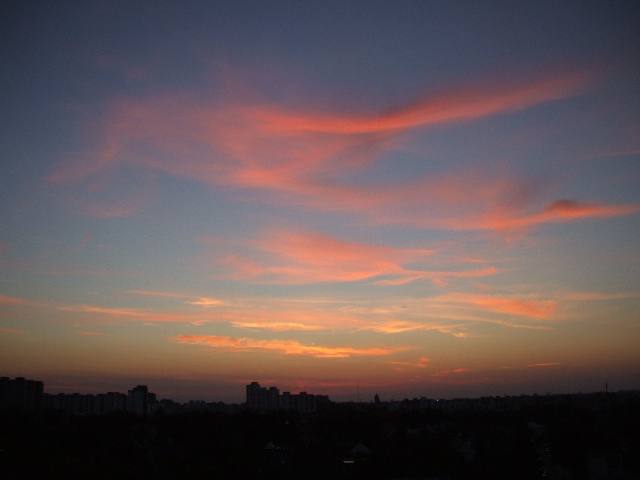
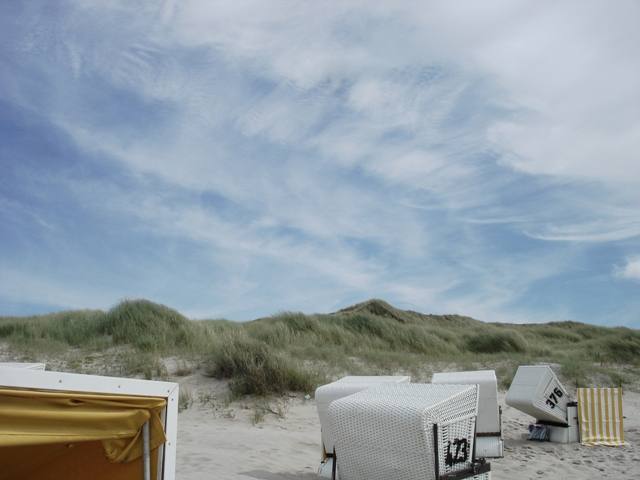
Cirrus fibratus Ci fib
Genus Cirrus, Species fibratus
- Photo
- Daniel Kröner
- Location
- Osnabrück · on the map
- Taken
- 29 July 2003
In the centre of the image, the fibres of Cirrus fibratus can be seen.
How Cirrus can form
The weather that day
Does the weather fit the cloud?
Cirrus ✓ observed Observer at Münster/Osnabrück · 29 km · further away · 8:00 Why?
- Observation: An observer at the Münster/Osnabrück station (29 km, 8:00) reports Cirrus.
Formation: Ice cloud at great height (usually above 6 km, below about −35 °C). Forms when moist air is lifted high up, or as left-over ice from convective clouds and contrails; falling crystals make the fibres.
How is this rated?
Observation before model: what an observer at a weather station reported counts for more than an estimate from a station’s instruments and more than the weather model. Each piece of information counts for less the farther away the station and the further from the time of the photo; the strongest comes first. The ERA5 reanalysis (grid point at the photo location, about 25 km grid spacing) only knows the cover per étage and values at the ground – its level is a rough estimate. As under “Sky now”, the satellite serves as an exclusion criterion: if it sees no matching cloud tops nearby, estimates count less; observations stay.
Seen from above time of the photo unknown
Sharp daily images from NASA satellites at this day’s overpasses. The time of the photo is unknown – which image comes closest to the sky when it was taken cannot be said.
More
More layers may lie below the top one: a cumulus with its base at 1 km often reaches up to 3 km. The satellite looks down on an area; the photo shows part of the sky from below.
The sky through the day
6:00
For comparison: ERA5 reanalysis
9:00
For comparison: ERA5 reanalysis
12:00
For comparison: ERA5 reanalysis
15:00
For comparison: ERA5 reanalysis
18:00
For comparison: ERA5 reanalysis
21:00
For comparison: ERA5 reanalysis
- ✓observed
- estimated: ●●● likely ●●○ quite possible ●○○ possible
- Photoalso in the photo
- Frame: station more than 20 or 50 km away
How to read the sky
- Times – click to see the sky at that hour. Below them the codes of the reported genera, grey = estimated only.
- clear = observer reports no clouds · none meas. = instrument detected none · ? = no data · – = partly hidden or without data (details on hover).
- ✓ = reported by a weather station, dots = estimated from height and cover (automatic measurement) or from the weather model. The bar next to the étage shows the cover.
- The card says where the information comes from – a station, the satellite or the weather model. Hover for the reasoning.
- The stations see their own sky – not necessarily the cloud in the photo.
Large-scale weather pattern
Disrupted bridge across central Europe BMz
Typical clouds in this pattern: Stratocumulus Altocumulus Cumulus Cumulonimbus
What does this mean?
The ridge over central Europe is broken by a low or an upper trough. Changeable but rarely very wet: stratocumulus and altocumulus, weakened fronts, and in summer a few showers and thunderstorms.
The weather pattern describes the flow over central Europe on that day – locally, the sky may have looked different.
Measurements on this day
Measured at Osnabrück (2 km S), not where the photo was taken.
- Temperature
- 11.4 to 25.7 °C
- Precipitation
- none measured – incomplete record (22 of 24 hours)
Between 19:00 and 21:00 the temperature dropped by 4.0 °C.
Course of the day
Data: German Weather Service, Copernicus/ECMWF, NASA · sources and licences
Sources: observations and measurements from Deutscher Wetterdienst, the German weather service (CC BY 4.0), Osnabrück (2 km S); weather pattern after Hess/Brezowsky from the DWD catalogue GWL-REA; ERA5 reanalysis by Copernicus/ECMWF (CC BY 4.0) via Open-Meteo. Sharp image: NASA Worldview/GIBS (Terra, MODIS Corrected Reflectance), overpass time from NASA’s granule search (CMR). Times in local time.



Write a comment or ask a question about this photo
Every comment is read before it is published. Your email address is only needed for the confirmation link and a short message once the comment is online; it is deleted after that.